
Building & Destruction in WARDOGS: FOB Setup Guide
WARDOGS building guide: every constructible from FOBs to AA gun positions, chokepoint siting, large-scale destruction, and how siege tools crack player bases.
Most shooters give you a wall to hide behind. WARDOGS lets you build the wall — and then lets the enemy bring artillery to take it down again. Construction and large-scale destruction are two halves of the same system, and together they turn the map into something players actually shape: forward bases that anchor offensives, anti-air nests that close the sky, and the siege tools built to erase both. This guide covers what you can build, where to build it, and how bases fall.
What you can build in WARDOGS
The building system is built around three confirmed structure types, each with a distinct strategic job.
| Structure | What it does | Strategic value |
|---|---|---|
| FOB (forward operating base) | Establishes a forward presence — a hardened anchor for your team’s push or defense | The centerpiece of WARDOGS base-building; controls ground |
| AA / SAM gun position | Turns a base into an anti-aircraft kill zone | Denies the enemy’s helicopter economy over a lane |
| Field fortifications | Cover and obstacles for infantry | Turns open ground into a defensible position |
Two things make this system interesting. First, destruction is symmetrical: the same physics that let you raise a FOB let artillery flatten it. Nothing you build is permanent, which is the point — a base is an investment, not a monument. Second, building is bought, not granted. Materials cost the same persistent cash as everything else in WARDOGS, so every wall is a spending decision.
No builder class — you buy the role
WARDOGS has no class system, and the official FAQ explains the philosophy in one line: what you buy is what you are. Buy medical supplies and you are the medic. Buy building materials and you are the engineer.
For base-building, that means:
- Anyone can be the builder at any time — no slot, no unlock, no queue.
- Your capacity to fortify is limited by your bankroll, not a skill tree.
- A team’s “construction budget” is whatever its members are willing to sink into the ground.
Practically, this makes builders economic players. The $10,000 starting bankroll (cash persists between matches) can become a FOB that wins the match or a pile of rubble that teaches you a lesson about artillery.
FOB siting: why chokepoints win matches
Where you build matters more than what you build. A FOB in a field is a donation to the enemy’s artillery kill feed; a FOB on a chokepoint is a toll booth on the entire match.
| Site type | Why it works | The risk |
|---|---|---|
| Chokepoint dominating objective lanes | Every enemy push funnels past your guns; you tax their tempo | High-value target — expect a dedicated siege response |
| Reverse slope / dead ground | Hull-down against direct fire; enemy armor cannot see the base | Artillery still arcs onto you — disperse the structures |
| Behind the active objective | Supports captures, re-arms your attackers, safe from frontal pushes | Useless the moment the fight moves on |
The siting logic is the same in every match: build where the enemy must go, not where you would like to stand. A base that the enemy can simply walk around is scenery. A base on the lane between their spawn and the objective forces a decision — siege it, or feed it.
Taking the sky: AA and SAM positions
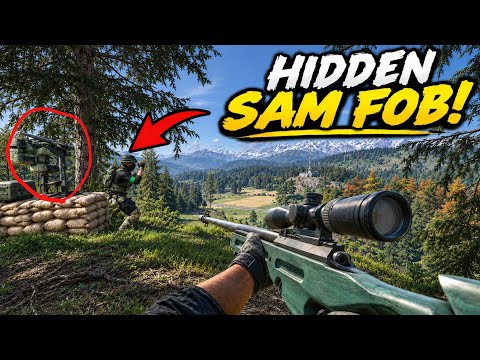
The most-discussed application of the building system is the air-denial FOB: a forward base whose real cargo is anti-air and SAM positions, planted on a helicopter corridor to shut down the enemy’s transport economy. The tactic is community-popularized — demonstrated on YouTube rather than documented by the developers — so treat its potency as strong-but-unproven. Its popularity alone tells you the shape of the meta: when the battlefield lifeline is a helicopter, someone will build a wall for the sky.
When building AA coverage:
- Site on the approach, not the objective. Kill corridors, not landing zones — helicopters that never arrive are worth more than helicopters you catch landing.
- Layer with terrain. Positions tucked into dead ground survive the counter-battery and the strafing run longer than positions on ridgelines.
- Expect the answer. A SAM FOB that shuts down a lane will eventually attract artillery, C4 teams, or an attack helicopter with a grudge. That is not a failure — a base that absorbs a siege is a base that is not being spent on your objectives.
How attackers crack a base
Every tool in the WARDOGS siege kit maps to a weakness in the building system, and knowing both sides makes you a better builder.
| Siege tool | How it breaks a FOB | The builder’s counter |
|---|---|---|
| Self-propelled artillery | Standoff demolition of structures from beyond retaliation range | Disperse structures, dig into dead ground, counter-battery |
| C4 breach team | Demolitions up close — including the community-famous helicopter-delivered C4 run (unverified) | Perimeter obstacles, AA coverage, sentries on proximity voice |
| Tank and autocannon fire | Collapses fortifications and guns by weight of fire | Hull-down siting, AT-capable defenders inside the position |
The helicopter-plus-C4 combination deserves its honesty label: it is a community tactic, reported and demonstrated by players rather than confirmed as a designed mechanic. But it follows the game’s logic perfectly — the cheapest way past a wall is to fly over it, and the cheapest answer to a flying bomb is the AA position the FOB should have had.
The economics of rubble
Every structure in WARDOGS is bought with cash that persists between matches, and every structure can be destroyed. Put together, those two facts define base-building’s real role in the economy: a FOB converts money into map control, and a siege converts map control back into rubble — while deleting the defender’s investment.
That gives builders a rule of thumb that doubles as a closing thought: build what the match needs, where the enemy must deal with it, and never spend more on a base than the objective it protects is worth.
Frequently Asked Questions
▸ What can you build in WARDOGS?
WARDOGS' building system centers on FOBs (forward operating bases), anti-air and SAM gun positions, and field fortifications — all constructed from materials you buy. Combined with the game's large-scale destruction, this makes base-building a genuine match-level strategy rather than decoration.
▸ Do I need a builder class to construct things in WARDOGS?
No — WARDOGS has no classes at all. The official FAQ is explicit: what you buy is what you are. Buy building materials and you are the engineer or builder for as long as you carry them. Anyone can fund and raise a FOB at any time.
▸ Where is the best place to put a FOB in WARDOGS?
Chokepoints. A FOB that dominates the lanes between the enemy and the objective controls the tempo of the whole match — every fight funnels past your guns. Avoid open ground and obvious positions that invite artillery; site where terrain protects the base and the base protects the route.
▸ Can a FOB shoot down helicopters in WARDOGS?
That is the community's favorite tactic: stacking anti-air and SAM positions into a dedicated air-denial FOB to shut down helicopter traffic over a lane. It is widely demonstrated on YouTube but not officially documented as a hard counter — treat it as a strong, popular strategy rather than a guaranteed mechanic.
▸ How do attackers destroy a FOB in WARDOGS?
With siege tools. Self-propelled artillery is the designated anti-fortification vehicle and can level a base from standoff range, C4-wielding breach teams demolish structures up close, and tank fire collapses whatever survives. Large-scale destruction is core to WARDOGS — no base is permanent.
Related videos
Related Articles
vehicles
How to Fly Helicopters in WARDOGS: Pilot Money Guide
Learn to fly WARDOGS helicopters: flight basics, transport vs. light attack models, charging passengers for rides, surviving AA fire, and HOTAS support status.
vehicles
WARDOGS Vehicles Explained: Tanks, Helicopters, Artillery & APCs
WARDOGS vehicle classes explained — tanks, artillery, APCs, transport and attack helicopters — with known prices, counters, and when to buy each.
Was this helpful?
Thanks for the feedback!